Certified Electronic Music Producer Program | Portland
Certified Ableton Music Producer Program
If you're ready to take your music seriously and want to master one of the world’s most powerful DAWs, this is where your journey begins. Whether you're starting from scratch or you’ve been self-teaching and want to fill in workflow gaps, our 120-hour Music Producer Program in Ableton Live Suite is built to help you produce high-quality, release-ready tracks while earning a certificate that proves your skills.
Ableton DAW
- →Session and Arrangement View, Workflow and Warping Basics
- →Warping Loops and Using the Browser
- →Intro to Simpler and Drum Racks
- →Drum Sampler
- →MIDI Recording of Melodic Instruments
- →Scales, Key and Tuning Systems
- →MIDI Generators and Transformations
- →Mapping for Remote Control
- →Audio and MIDI Effects and Racks
- →Using Third Party Plugins
- →Recording Audio and Warping Full Tracks
- →Comping: Take Lanes
- →Stem Separation
- →Mixing Basics, Grouping and Routing
- →Auto Shift
Advanced Ableton
- →Sub: Waveforms and Harmonics, Sine
- →Sub: Ableton’s Analog: Oscillators
- →Sub: LFO, Polyphony, Unison and Glide
- →Pulse Width Modulation and Serial Filtering
- →Drift: Subtractive, Done Properly
- →FM: Intro to FM
- →FM: Ableton’s FM synth: Operator Overview
- →FM: Algorithms, Filter
- →FM: Making FM Drum Sounds
- →Wave: Wavetable Categories
- →Wave: Auditioning Wavetables Using an Envelope
- →Wave: Oscillator Effects
- →Wave: Multiple Filters with Different Routings
- →PM: Physical Modeling Synthesis
- →PM: Collision and Corpus: Sound Design
- →PM: Tension
- →Filter, LFO FX and Modulation Matrix
- →Waveshaping with Roar: Saturation, Dist
- →Sampler: Mapping Key and Velocity Zones, Looping
- →Sampler: Filter, Drive and Shaper
- →Sampler: AUX Env and LFOs
- →Granular: Creative Time Stretching
- →Granular: Beat Mode, Warping Using Quantized
- →Granular: Grain Delay
- →Granular: Granular Synthesis with Granulator III
- →Granular: Filter, Modulators and Capture
- →Additive synthesis: in Operator
- →Creative Audio Effects: Shifter
- →Creative Audio Effects: Resonators
- →Creative Audio Effects: PitchLoop89
- →Spectral Resonator and Spectral Time
- →Hybrid Reverb
- →M4L Devices: M4L Modulators
Mixing & Mastering
- →Choosing Monitors
- →Monitor Placement
- →Acoustics: The Basics
- →Signal Flow
- →Mixing Desk Basics
- →Basic panning techniques
- →Mid/Side and Stereo Width
- →Equalization
- →Filtering
- →Dynamics
- →Reverb
- →Delay
- →Phaser and Flanger
- →The Vocoder
- →Modulation
- →Vocals
- →Automation: Mixing as a Performance
- →More Creative Mixing Techniques
- →Mixing Electronic Music
- →Mastering
Mentoring
- →20 hours of working on your music in class!
Designed for the next generation of artists and producers, this immersive course is hands-on, practical, and focused on results. You’ll work directly on your own music, receiving detailed feedback and guidance tailored to your goals and your genre.
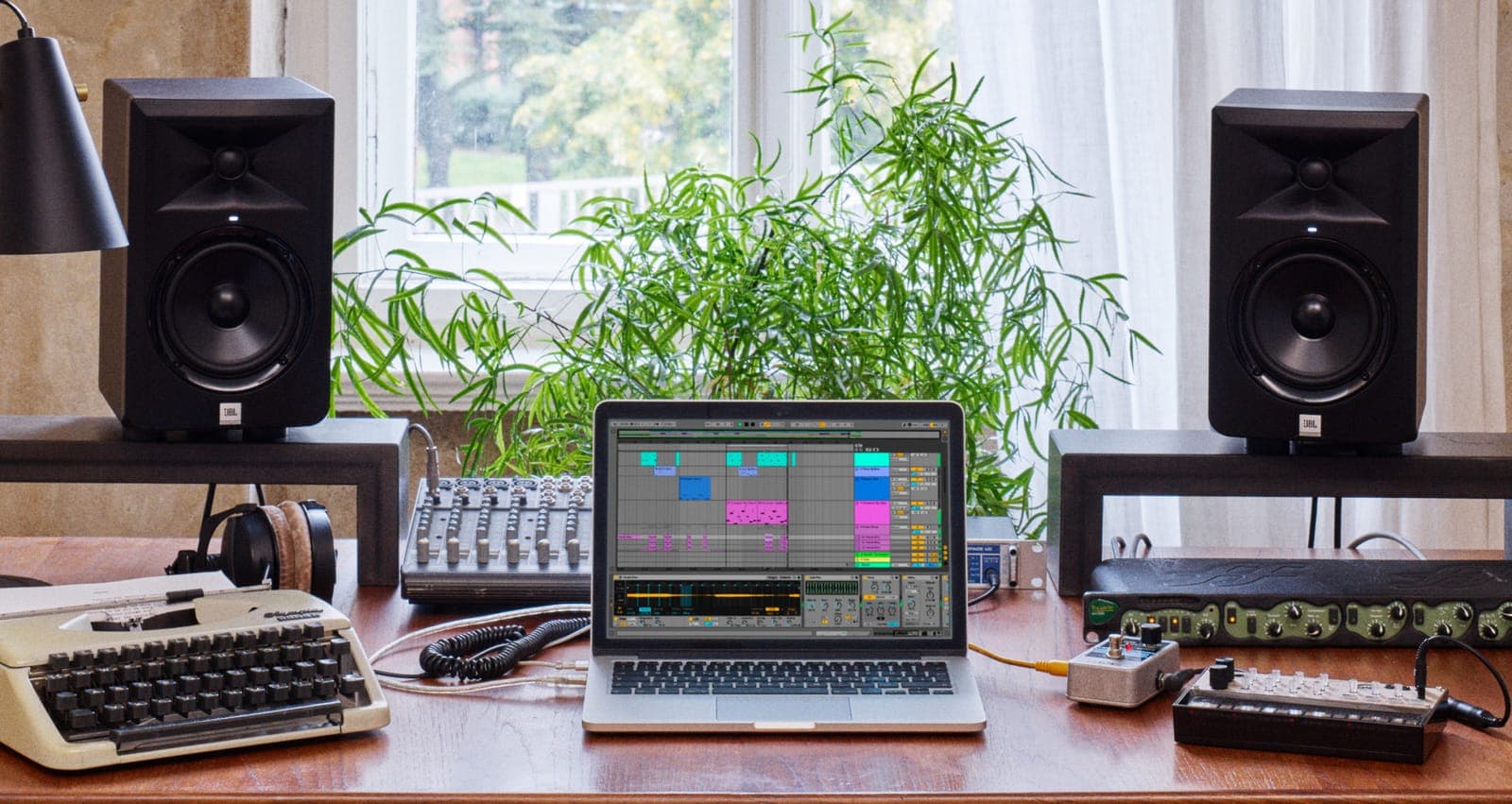
You’ll dive deep into Ableton Live Suite, learning how to use it as a creative weapon. From sampling and sound design to audio manipulation and live performance techniques, this course covers the entire spectrum of music production. We’ll also show you how to seamlessly integrate hardware, turning your workflow into a fast, expressive, hands-on experience.
Sound design is a big focus too—you’ll explore the best of Max4Live devices and get under the hood with Serum, the only third-party plugin featured in the course, to create truly unique sounds.
Our class sizes are intentionally small—no more than 10 students per class—so you can learn in a relaxed, collaborative environment. Our purpose-built labs encourage experimentation, creativity, and even the occasional class jam. Because learning to produce the music you love should be inspiring, not overwhelming.
And the perks? Yeah, we’ve got those: Thanks to our exclusive licensing partnerships, you’ll get access to a suite of premium synths, samples, and effects—worth thousands. Many are yours to keep. Others are free to use during the course, with exclusive discounts available if you want to upgrade later.
And there’s more: as a Garnish student, you’ll receive our full boutique sample library—created by Garnish instructors and producers—for free. Plus, you’ll get an exclusive student-only pack featuring individually sampled keys from Mark Ronson’s Mellotron M4000D, lovingly recorded in Mark’s Hollywood studio by our own Zack Johnson. Huge thanks to Mark and Zack for making this one-of-a-kind resource available to our students.
Whether you want to make club bangers, cinematic soundscapes, or experimental grooves, this program gives you the tools, knowledge, and mentorship to make it happen.
In Portland this course is deliberately small: a handful of students, one working producer, and plenty of time on the equipment. If getting to the studio is not practical, the same classes run live online, using our specialist music collaboration software, Muse.
Ableton certified; Apple authorized; world-class facilities; superior roster of instructors.

What our students say.
“Taking this course was probably one of the best decisions I have made in my career thus far”
Mandi Perkins
Questions we hear a lot.
Yes - it's designed for complete beginners as well as more experienced self-taught producers.
Yes - you'll learn to bring hardware into your Ableton workflow for a faster, more hands-on process.
Yes - the program is built to certify your production skills.
It includes individually sampled keys from Mark Ronson's own Mellotron M4000D, recorded specifically for Garnish students.
120 hours total.
No more than 10 students per class.
$4,499 + $100 registration fee
Ready to get started?
InquireWaveshaping with Roar: Saturation, Dist
Roar is a saturation effect that is capable of adding overtones and color or extreme distortion and glitchy effects.It features several non-linear…
Read →Sampler: AUX Env and LFOs
AUX Env and LFOs are powerful modulation tools available in Ableton’s Sampler. They allow you to shape and modulate the sound of your samples in various…
Read →PM: Physical Modeling Synthesis
With PM we can create quasi acoustic sounds, such as a plucked guitar, string, flute or drum hit. But other than with samplers we can also tweak…
Read →Wave: Wavetable Categories
Unlike what we’ve seen in Analog that only uses a few basic waveforms as a source, Wavetable has two special type oscillators that contain hundreds of…
Read →Link, Tempo Follower and MIDI Sync
Playing in time with other people, other software and other machines. Link over a network, Tempo Follower chasing a live drummer, and old-fashioned MIDI clock.
Read →Hybrid Reverb
Convolution and algorithmic reverb in one device, blended. Real spaces for the early reflections, a synthetic tail behind them - and why that combination sounds better than either alone.
Read →